Understanding and analyzing a value chain means identifying how an organization creates added value, who it works with, and where its impacts lie. In the context of the ecological transition, the value chain becomes a strategic lever to rethink your business model and build an innovative, sustainable and resilient economic model that integrates the circular economy.
What you should remember:
- The value chain is an essential tool for analyzing how an organization creates added value and identifying its strategic levers.
- In an uncertain world, companies can no longer create value on their own. They must cooperate with their partners and take into account the entire life cycle of their products and services.
- The value chain in the circular economy is a way to rethink the design of products and services, integrating sustainability and reuse criteria from the outset.
- The Value Chain Canvas and Circulab Academy courses help you map, rethink and evolve your business model to make it circular, innovative and resilient.
What is a value chain?
Origin and definition by Michael Porter
The concept of the value chain was introduced in 1985 by Michael Porter, a professor at Harvard. It starts from a simple idea: every organization creates added value by combining different activities, from procurement to after-sales service.
In his original model, Porter distinguishes two types of activities:
- Primary activities: inbound logistics, production operations, outbound logistics, marketing and sales, services.
- Support activities: infrastructure, human resource management, technology development, procurement.
This distinction helps companies better understand their cost structure and competitive advantages, and prioritize their investments.
From internal analysis to an ecosystem view
Since its introduction, the value chain has evolved. It is no longer analyzed only at the internal level of a company, but from a much broader perspective: that of ecosystems.
Today, an organization can no longer create value on its own. In an uncertain world, marked by volatile raw material prices, geopolitical crises, climate disruption and rapid regulatory changes, risks are multiplying and becoming more complex.
In 2024, cocoa prices reached a record high of over 10,000 dollars per tonne, mainly due to poor harvests in West Africa linked to climate change and crop diseases. For chocolate makers and the entire sector, this price surge highlighted their dependence on a key resource concentrated in a few producing countries.
That is why value creation now relies on cooperation through strategic partnerships, the integration of new revenue streams and taking environmental and social impacts into account.
How business models and value creation are evolving
From added value to value propositions
For a long time, companies designed their business models mainly around cost reduction and internal optimization. Today, this approach is no longer enough: customers, investors and regulators expect companies to demonstrate their ability to create differentiating value propositions that integrate the notion of impact.
New business models
Current changes are encouraging organizations to experiment with innovative business models that integrate circular economy principles (reuse, selling a service rather than a product, sharing resources, etc.). To support this transformation, visual tools such as those developed by Circulab have become established (Value Chain Canvas, Partner Map, Circular Canvas).
Why transform your value chain in the era of the circular economy?
Integrating the life cycle and impacts
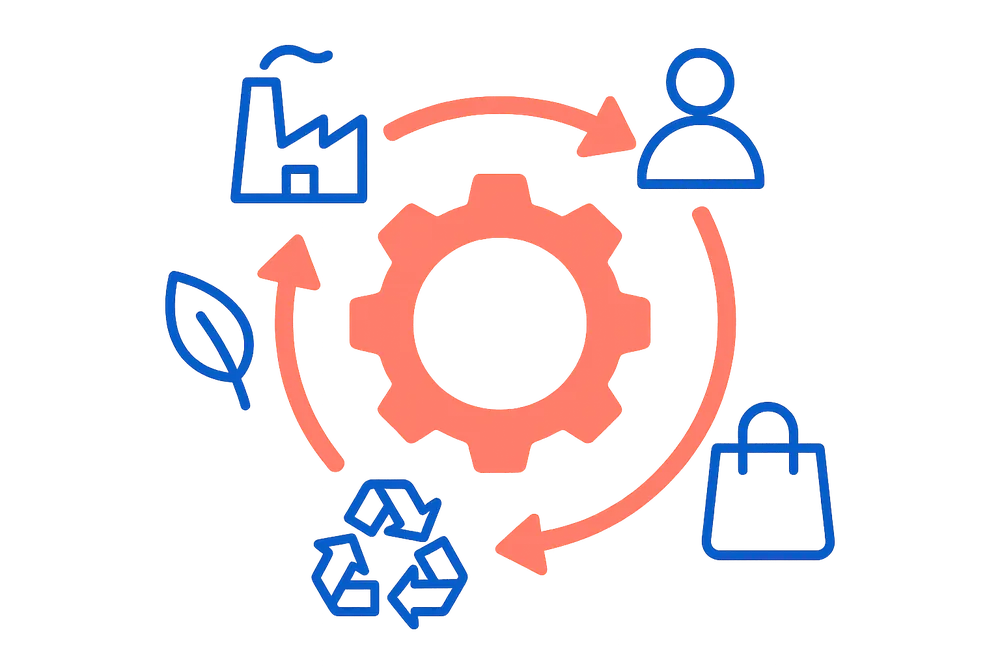
The circular economy changes the way a value chain is designed. Where traditional approaches focus on production and distribution, circular thinking integrates the entire life cycle: extraction of raw materials, design, use, reuse, end of life and regeneration of resources.
Building an innovative and resilient business model
A company that revisits its value chain according to circular economy principles can diversify its revenue streams, develop new partnerships to secure its supplies, innovate in design, and anticipate regulatory changes.
Strategic tools to map and innovate
Visualizing your value chain and spotting opportunities
The Value Chain Canvas is a strategic tool that makes it possible to map an entire value chain at a glance. Thanks to this broader view, a company can spot areas of waste or excessive dependence, identify opportunities for circular value creation, and anticipate environmental and social impacts at each stage of the life cycle.
Complementary tools
The Circular Canvas makes it possible to structure an innovative business model by integrating the Rs and the 7 pillars of the circular economy (according to ADEME). The Partner Map makes it easier to identify strategic partnerships and cooperate with the various stakeholders in the ecosystem.
Courses to build and evolve your business model
Circulab Academy offers progressive learning paths adapted to your level of experience: Discover, Apply, Deploy. The "Supporting the transformation towards a circular economy" program lets you master the complete circular design method, with the Value Chain Canvas, the Partner Map and the Circular Canvas. It is a comprehensive course, designed for CSR, innovation or purchasing managers.
In short
In a context marked by resource scarcity, climate crises and regulatory pressure, reducing costs or optimizing processes is no longer enough. It has become necessary to design innovative, circular and resilient business models. With the Value Chain Canvas and the Circulab method, you have concrete tools to map your activities, spot opportunities and transform your value chains.
Sources:
- Michael Porter, Competitive Advantage: Creating and Sustaining Superior Performance (1985)