The textile sector alone concentrates major ecological, social and health impacts: resource depletion, pollution, precarious work. In a world marked by scarcity and regulatory pressure, companies must learn to do better with less. Understanding these issues is the first step towards building a more sustainable and resilient industry that integrates the principles of the circular economy.
What you should remember:
- Textiles concentrate major ecological, social and health impacts: overproduction, pollution, precarious work.
- The circular economy offers a concrete framework: eco-design, reuse, second hand, new business models centered on use.
- The specific features of the industry require the principles of the circular economy to be adapted strategically.
- Regulations are already accelerating the change and strengthening transparency.
- Companies must map their impacts, rethink their business model, train their teams and cooperate across the industry.
The systemic impacts of textiles
Landscapes turned into global dumps
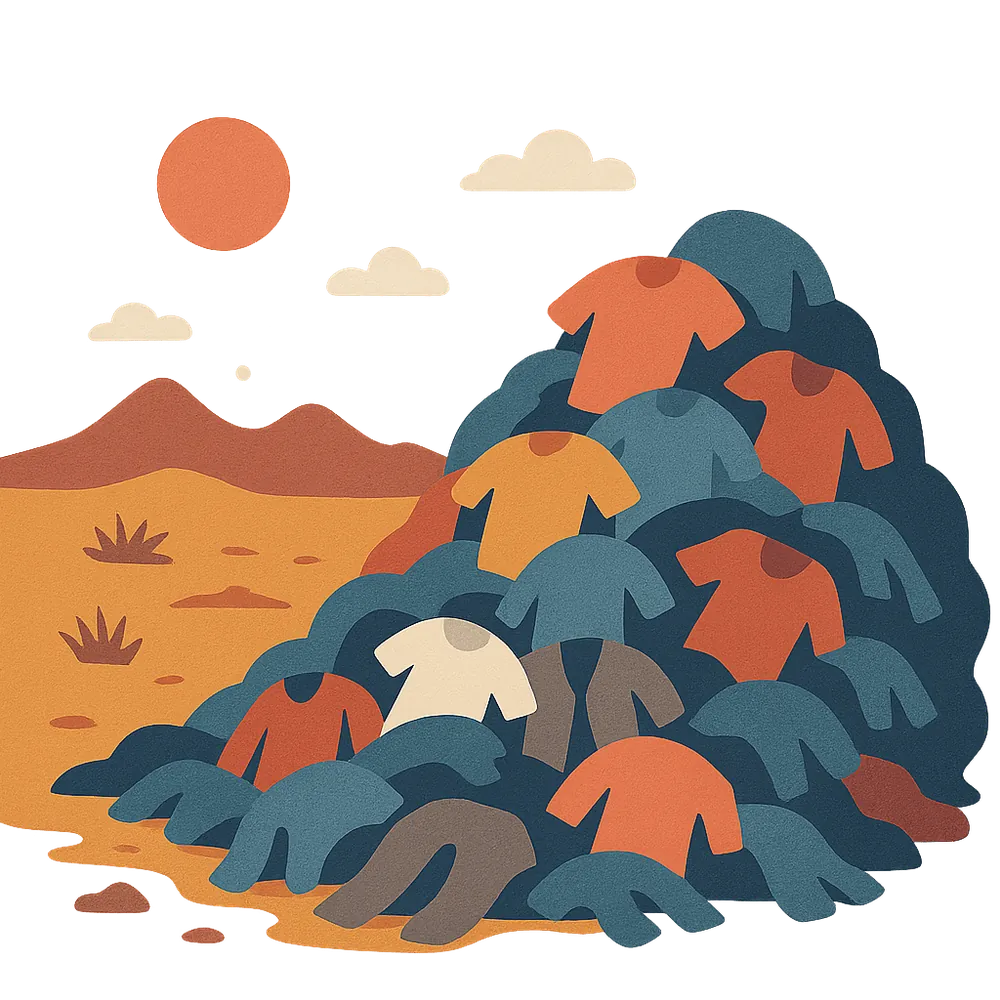
In Chile, the Atacama Desert has become the symbol of the excesses of fast fashion. Every year, tens of thousands of tonnes of unsold or discarded clothes pile up there. Some of them are burned, releasing toxic fumes that directly affect the health of local residents. A model based on overproduction always ends up moving its waste elsewhere.
When fashion comes at the expense of human rights
According to the International Labour Organization, 79 million children around the world work in unsustainable and dangerous conditions. These conditions reveal a system that helps perpetuate precariousness and inequality.
Toxic materials for the planet and for us
Cheap synthetic fibers (polyester, acrylic) and some dyes contain harmful substances (endocrine disruptors, microplastics, heavy metals). Every wash releases micro-particles into the water, which end up in the oceans and the food chain.
The principles of the circular economy applied to the textile sector
Closing the loop by moving from linear to circular
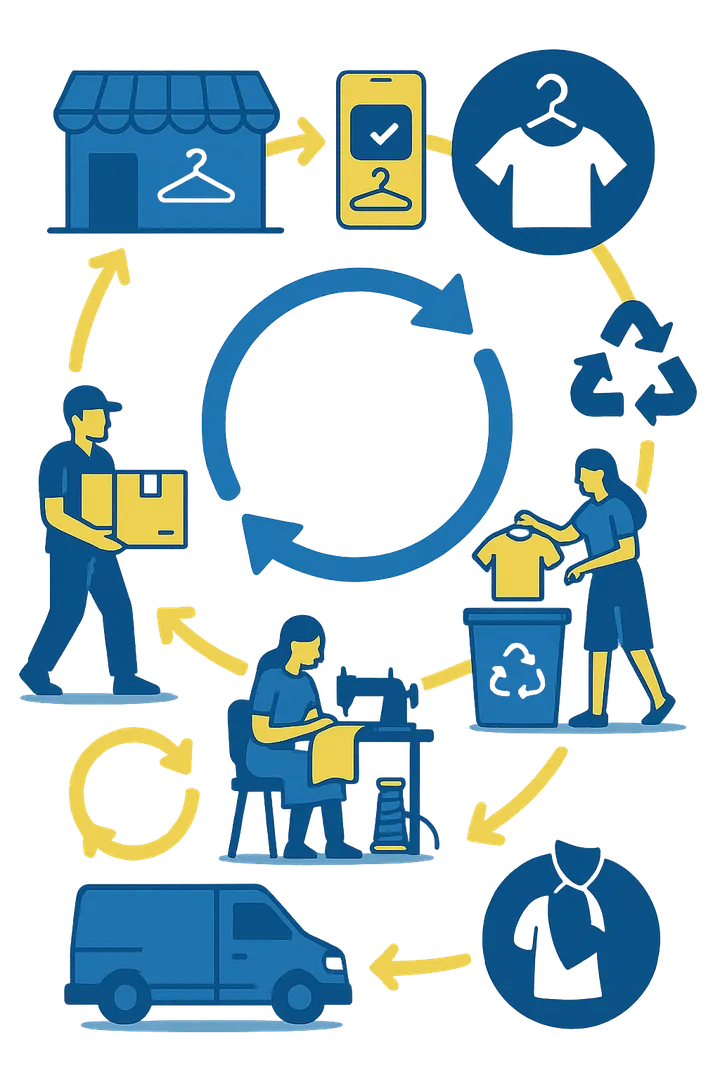
The circular economy replaces the linear model (extract, produce, consume, throw away) with a virtuous loop: keeping resources in the economy, limiting what goes out (waste) and what comes in (raw materials).
The 7 pillars of the circular economy adapted to textiles
- Sustainable sourcing: favor organic, recycled or low-impact fibers (hemp, linen, Tencel). Example: Drekks makes jeans from hemp grown and processed in Normandy, without pesticides or excessive water use.
- Eco-design: avoid complex blends to make recycling easier, design with repairability, modularity and durability in mind.
- Industrial and territorial ecology: fabric scraps from one factory can become inputs for another local industry.
- Functional economy: renting an outfit rather than buying it, subscription services for children's clothing. Examples: Anett (rental and maintenance of professional textiles), Le Closet (fashion subscription for individuals).
- Responsible consumption: the rise of second hand, repair and upcycling.
- Extending the period of use: alteration services, repair workshops, clear care instructions.
- Waste management: selective collection and recovery are essential; in France, the EPR scheme requires brands to fund collection and sorting.
Turning challenges into opportunities
Complexity of fibers and blends (favor single materials whenever possible); volume and pace of production (according to the Ellen MacArthur Foundation, clothing production doubled between 2000 and 2015 while use declined); outsourcing of production (the ESPR regulation and the Digital Product Passport require a transformation of traceability); the strong cultural and emotional dimension of clothing.
How to deploy a circular and sustainable textile strategy in your company?
Mapping your impacts to build your strategy
At the strategic level: tools such as the Circular Canvas or the Value Chain Canvas to visualize critical dependencies and identify vulnerabilities in the value chain. At the operational level: Life Cycle Assessment (LCA) to measure environmental impacts (water, energy, emissions, microplastics).
Reinventing the business model
Moving from sales to use (rental, subscription, leasing) extends the period of use and generates recurring revenue. Integrating second hand and take-back makes it possible to capture residual value. Creating new services (repair, maintenance) completes the offer. With a circular approach, value is no longer limited to immediate revenue: it is also measured in reduced risks and customer loyalty.
Anticipating regulation
The textile sector is directly affected by the changing regulatory framework: the AGEC law, the EU strategy for sustainable textiles, the ESPR, Digital Product Passports. Companies that adapt early turn the constraint into a competitive advantage.
Training and uniting your teams
Training enables teams to understand the 7 pillars, use tools such as the Circular Canvas, and deploy a common vision, avoiding siloed approaches.
Cooperating to amplify impact
Textile circularity requires cooperation across industries and territories: pooling collection, sharing second-hand platforms, jointly funding research into new processes. In France, working with Refashion (the textile industry's eco-organization) allows brands to fund collection and sorting.
In short
Textiles are one of the most polluting and socially criticized sectors, marked by overproduction, complex fibers and globalized supply chains. The circular economy provides solutions through eco-design, reuse, second hand and new models centered on use rather than volume. For companies, the key is to map their impacts, rethink their business model and anticipate these changes.
Sources:
- Oxfam France, The impact of fashion: a social, health and environmental disaster
- National Geographic, Fast fashion goes to die in the world's largest fog desert
- ADEME, Circular economy: definition, challenges and concepts
- Ellen MacArthur Foundation, Circular business models: redefining growth for a thriving fashion industry (2021)