Today, it's impossible to ignore the circular economy. But what does this concept really mean? Why is it becoming central to business strategies?
In this article, we offer a complete overview to help you understand what the circular economy is, why it has become essential, and how to integrate it into your business.
What you should remember:
- The circular economy isn't just about recycling: it's a shift in economic model, based on reducing impacts, fostering cooperation, and creating lasting value.
- Moving from a linear to a circular model requires systems thinking and a transformation of value chains.
- Many companies have already begun this transition and show that another model is not only possible, but more resilient and sustainable.
- To understand, structure, and deploy a circular strategy, training is an essential starting point.
What is the circular economy?
According to ADEME, the circular economy is "an economic system of exchange and production which, at every stage of the life cycle of products (goods and services), aims to increase the efficiency of resource use and reduce environmental impact while developing individual well-being."
So the circular economy isn't just about recycling our waste or extending product lifespans. It represents a complete transformation of our economic and social models, grounded in systems thinking, cooperation between actors, and respect for planetary boundaries.
It's based on three major principles:
- Preserving natural resources.
- Closing the loop on the life cycles of products and materials.
- Creating economic and social value at every stage.
The "Rs" of circularity
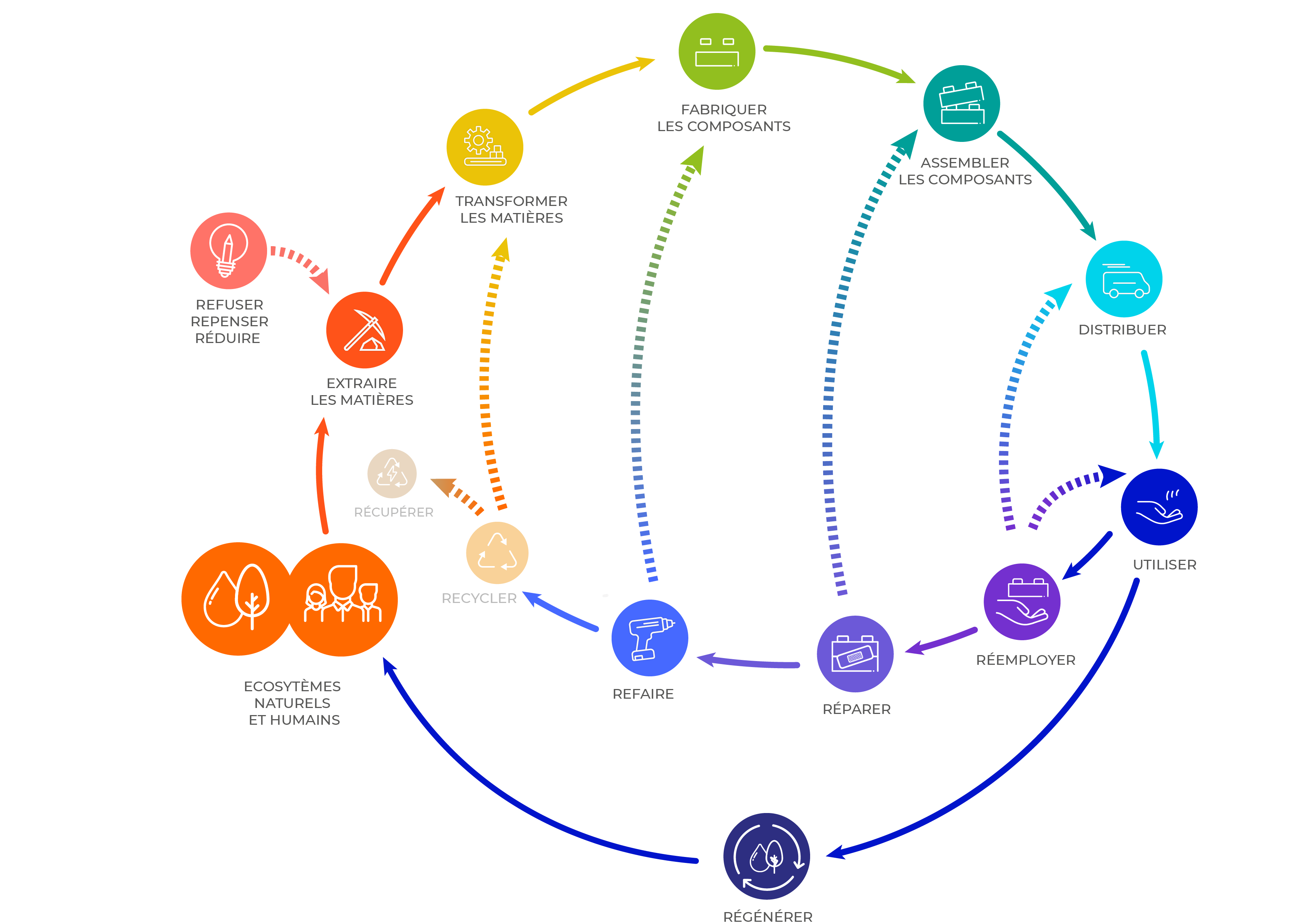
This vision takes shape in a hierarchy of actions: the "Rs" of circularity, which can range from 3 to 10 depending on the framework used. At Circulab, we favor the following 8: Refuse; Reduce; Reuse; Repurpose; Repair; Remanufacture; Recycle; Regenerate.
The further upstream we act in this chain (that is, from the design stage), the more impacts we avoid and the more value we preserve. In fact, 80% of a product's or service's impacts are determined right at its design stage.
This is why organizations need to make sure, from the ideation stage of their offerings, that they align with the boundaries imposed on us.
At Circulab, we use the Circular Canvas©, the Value Chain Canvas©, and the Partner Map© to help companies visualize their system and design solutions compatible with planetary boundaries.
Why is the circular economy becoming a strategic priority?
A context under pressure: resource depletion and environmental pressures
The linear economy, based on extracting, producing, over-consuming resources, then discarding, is now showing its limits. We see this every day, whether in our professional activities or in our personal lives.
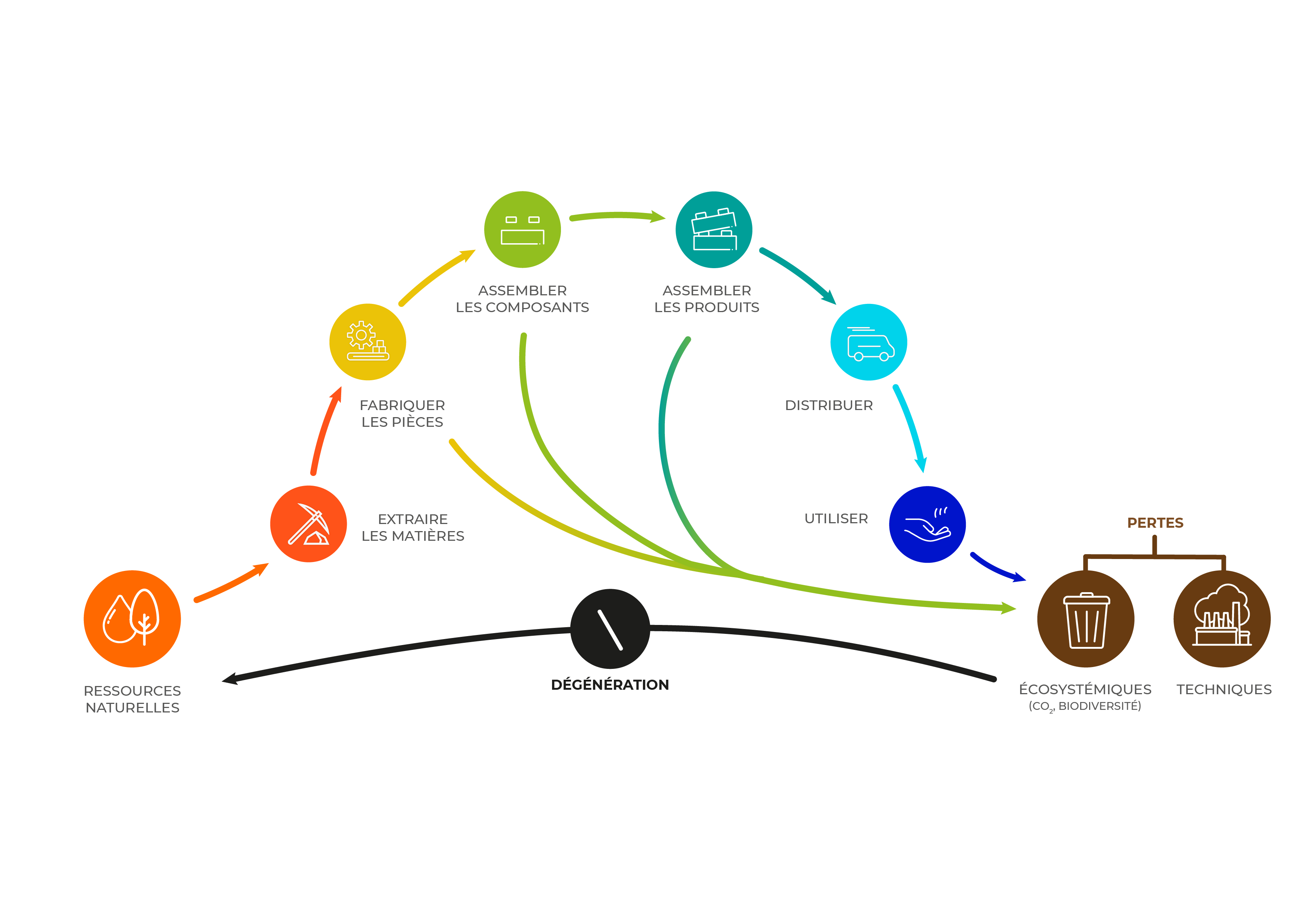
As natural resources become depleted, tensions over supply are intensifying. For example, according to the World Resources Institute, fresh water, essential to agriculture and industry, faces critical water stress in nearly a third of the world's countries. At the same time, extreme temperature fluctuations, biodiversity loss, and multiple forms of pollution are undermining the resilience of our ecosystems and our economies.
In sharing this, our goal isn't to discourage you, but simply to show that the rules of the game have changed.
Shifting societal, regulatory, and market expectations
Citizens are increasingly attentive to the environmental and social impact of the products they consume. This pressure also translates into growing regulation: the AGEC law, EPR schemes, the digital product passport, the ESPR directive... So many mechanisms that encourage, or even require, companies to change their model.
So in this uncertain, ever-changing context, sustainable development, and the circular economy in particular, become a strategic lever to anticipate, transform, and stay competitive.
The 7 pillars of the circular economy
To guide the transition toward a concrete circular economy, ADEME offers a framework of 7 pillars. These pillars provide a structuring lens to identify levers for action at every stage of a product's or service's life cycle, from the choice of raw materials to end-of-life management.
- Sustainable sourcing
Choosing recycled, bio-based, or locally sourced raw materials reduces pressure on natural resources. - Eco-design
Thinking about the product from the design stage to limit its impacts at every stage of its life cycle. A life cycle assessment (LCA) can be carried out upstream to analyze all incoming and outgoing flows at each stage of a product's life cycle. - Industrial and territorial ecology
Pooling flows (energy, waste, heat) between actors in a given territory helps create local value loops. - Functional economy
Rather than automatically selling a product, you offer a use or a service. This pushes you to design robust, repairable, durable products. - Responsible consumption
Involving customers in informed, sober purchasing choices aligned with environmental values. - Extending the useful life
Repairing, maintaining, and reusing to avoid disposal. - Recycling
Recovering material when all other strategies have failed. Recycling is useful, but should be thought of as the last resort, since it consumes energy and causes materials to lose value.
Is the circular economy the solution to business challenges?
Concrete benefits
Far from being limited to recycling or waste management, the circular economy offers a new lens to address environmental, social, and economic tensions. For companies, it represents as much a lever for innovation as a condition for medium-term survival. Among other things, the circular economy lets you:
- Create new revenue streams
By developing repair services, subscription offers, reuse or refurbishment solutions. - Reduce costs
By limiting raw material purchases, simplifying logistics chains, or reselling unsold inventory. - Gain resilience
By diversifying sources of supply and strengthening ties with local actors. - Differentiate sustainably
By meeting growing consumer expectations and anticipating upcoming regulations.
The main limits and challenges of this ecological transition
But every profound transformation comes with challenges. The transition to a circular economy involves much more than a technical adjustment. It notably requires you to:
- Change your perspective
By moving beyond a logic focused solely on immediate economic performance. - Shift mindsets
By uniting stakeholders, internal and external, around a shared vision and objectives everyone supports. - Work cooperatively
No single actor can succeed alone in this economic model transformation.
As Brieuc Saffré, co-founder of Circulab, often says: "The open bar is over." The question is no longer whether we need to change, but how we're going to do it.
What are the first steps to integrate the circular economy?
Get trained and raise awareness
Before taking action, it's essential to understand the main current environmental challenges and impacts. Training is the first lever to build skills, align teams, and trigger a shift in mindset.
- Collaborative workshops
Short, playful formats like the "fresques" (climate, circular economy, sustainable engagement, eco-design, biodiversity) or our Circulab workshop "What if we played to design the circular economy?" effectively raise awareness of the issues. - MOOCs and free courses
Several free online courses let you explore the fundamentals. Circulab offers a MOOC on Coursera, designed with ESSEC, to understand the principles of the circular economy, its environmental impacts, and begin an ecological and social transition at your own pace. - Advanced courses
Since 2015, Circulab Academy has helped you build circular economy skills through 4 levels of training: Discover the principles and opportunities; Apply the pillars and the "Rs"; Deploy circular models; Get equipped with our circular design method (Circular Canvas©, Partner Map©, Value Chain Canvas©).
Diagnose your current model
Before taking action and starting to create an innovative business model, let's go back to the start to better understand what already exists.
At Circulab, we systematically carry out an assessment of the existing situation, notably with the Circular Canvas©. It lets us analyze the main environmental, social, and economic impacts and risks associated with a business model. Once we understand your dependencies and vulnerabilities, we can act on them by defining and prioritizing relevant key actions in line with your context.
Build an environmental roadmap
Now, let's imagine you've been trained in circular design, taken part in a few collective intelligence workshops, drawn inspiration from companies that have taken the leap, and even carried out a full assessment on the Circular Canvas© along with other diagnostics. What next?
It all depends on your objectives, of course, but it's essential to define a circular strategy that's tailored and shared by everyone. You can then create a roadmap, a short-, medium-, or long-term action plan, transform your business model to generate other revenue streams, and build strong territorial collaborations.
In short
The circular economy isn't just about better waste management. It's a complete paradigm shift, based on the ability to think in systems, cooperate, and innovate. Companies that commit today will be best prepared for tomorrow's regulations, societal expectations, and ecological shifts.
Sources :
- ADEME. https://economie-circulaire.ademe.fr/economie-circulaire
- World Resources Institute. https://www.wri.org/data/water-stress-country