New initiatives are emerging everywhere: buildings designed for disassembly, second-life platforms for electronic equipment, packaging deposit systems and renting rather than buying. These circular models are redefining production and consumption. Training in the circular economy is becoming necessary to stay competitive in this market in transition.
What you should remember:
- Circular business models create value by reducing risks and dependence on resources.
- Training your teams provides a method and concrete tools to rethink your business model and anticipate regulatory changes.
- Circulab Academy offers two programs that guide you from understanding to implementing a circular strategy.
- Circulab tools structure your approach, engage your teams and make it possible to create sustainable, resilient models.
Key skills to acquire on circular models
Transforming sustainably requires rethinking value creation itself. Circular models call for a systemic vision, the ability to innovate and a fine understanding of the interactions between resources, actors and uses.
Understanding the principles of the circular economy
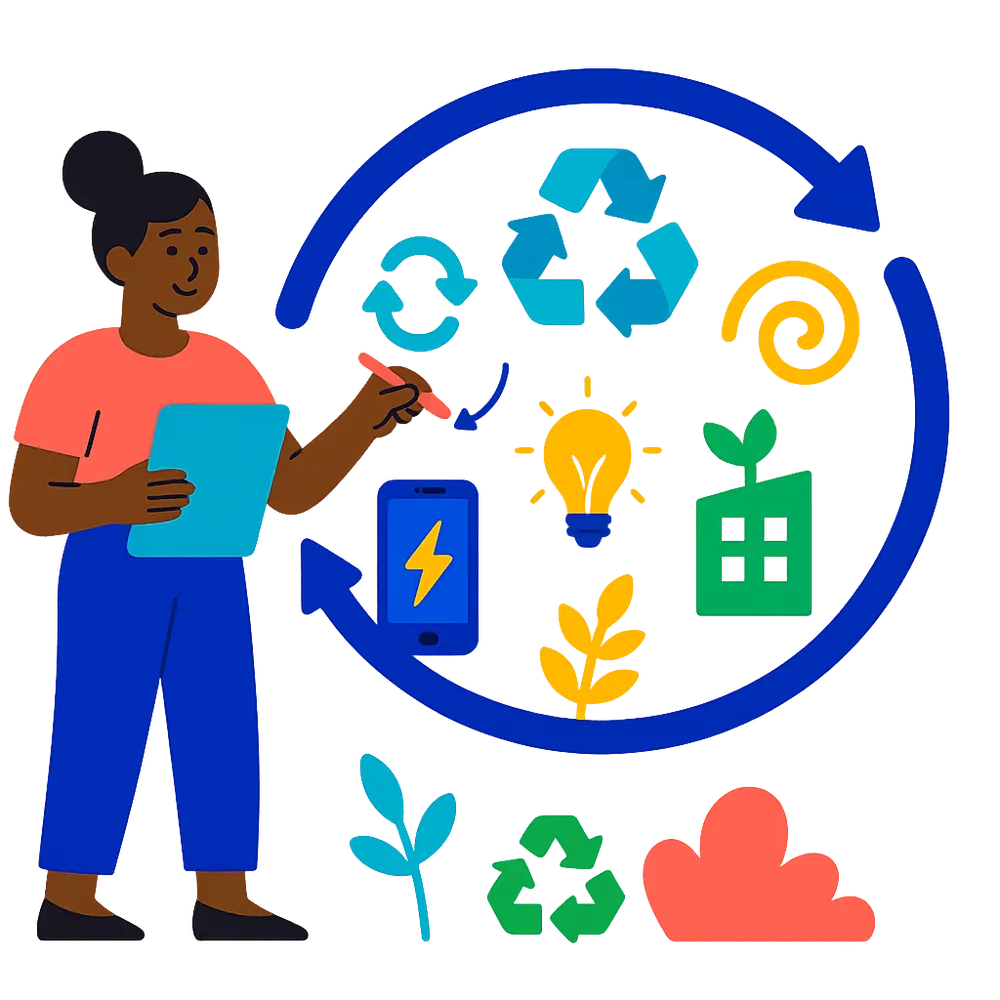
The circular economy draws on ADEME's 7 pillars (from sustainable sourcing to responsible consumption) as well as the "11 Rs" (Refuse, Reduce, Reuse, Repair, Recycle, etc.). This approach rethinks the design, use, maintenance and recovery of products, prioritizing reduction, the reuse of resources and the creation of virtuous loops between actors.
Moving from linear to systemic thinking
The circular economy is about thinking differently, doing better with less in an uncertain world. Moving from a linear to a circular model means "thinking in systems": understanding how flows of materials, energy, data and value circulate. This skill makes it possible to identify dependencies, bottlenecks and opportunities for cooperation, by rethinking supplier-customer-partner relationships to build more resilient and cooperative business ecosystems.
Designing a new value proposition
The heart of the circular model is a rethought value proposition, one that aligns technical feasibility, economic performance, resilience, positive impacts on ecosystems and stakeholder expectations. This can include offers based on use (the functional economy), repair/take-back services, or the recovery of end-of-life resources. This capacity for innovation sets pioneering companies apart from mere followers.
Which courses should you take to create a circular business model?
Rethinking your business model in the era of the ecological transition requires a clear method, suitable tools and a fine understanding of economic, environmental and social dynamics. Circulab Academy courses help you move from theory to action, whatever your level of maturity on the subject.
Progressive learning paths to build skills
Four training levels support companies at every stage of their transformation:
- Discover: understand the foundations and opportunities of the circular economy.
- Apply: identify levers for action and integrate circularity into your activities.
- Deploy: design and manage a circular economy strategy across the organization.
- Get equipped: master the Circular Design method and Circulab tools (Circular Canvas, Partner Map, Value Chain Canvas).
Two flagship programs to create circular value
Develop a sustainable, circular and resilient business: a 15-hour course, ideal for understanding resilience and designing business models with a positive impact. It teaches you how to assess the risks and identify the dependencies associated with your business model.
Supporting the transformation towards a circular economy: a comprehensive 45-hour program to master the Circular Design method and three key tools: Circular Canvas, Value Chain Canvas and Partner Map. By the end of the course: the ability to manage circular economy projects from A to Z.
Why get trained in circular business models?
As linear models show their limits, companies that master the principles of circularity are getting ahead.
A changing economic and regulatory context
Organizations operate in an uncertain and unpredictable environment. Between geopolitical tensions, debates over customs tariffs and high supply risks, companies find themselves weakened. The regulatory framework is also tightening: the European ecodesign regulation (ESPR) introduces new traceability requirements through the digital product passport.

An opportunity for businesses
Circularity is not just a constraint, but a real lever for innovation and competitiveness. Companies can:
- Reduce costs and risks thanks to a better view of the impacts and dependencies of their business model.
- Create new revenue by moving towards an economy of use rather than ownership.
- Become more attractive to customers thanks to offers that meet their expectations.
- Gain resilience in the face of economic, climate and logistics crises.
Proven tools to structure your approach
Circulab has developed collaborative, unifying tools that help companies understand systems, identify levers for transformation and design sustainable, circular and resilient solutions.
The Circular Canvas
The Circular Canvas helps visualize the impacts (economic, social and environmental) of a business model, and also helps rethink how the company creates value.
The Partner Map
The Partner Map makes it possible to map the ecosystem of actors in order to better understand the links, dependencies and complementarities between partners.
The Value Chain Canvas
The Value Chain Canvas gives an overall view of the value chain, from suppliers to end users, and helps map risks, dependencies and opportunities for improvement.
Concrete applications in business
Inter-company and in-house courses have helped many organizations accelerate their transition and transform their business models.
Moving from theory to transformation
With the Circulab method, companies learn to analyze their value chains, rethink their offers and design business models suited to the challenges of the 21st century.
Companies already committed to the transition
La Poste/Nouvelle Attitude illustrates the power of this approach. This subsidiary used Circulab tools to design a model for collecting and recovering office paper, aligned with the principles of the circular economy. The teams were able to identify new levers for value creation: waste reduction, pooling of logistics flows and additional revenue generated through recycling.
In short
Rethinking your business model in an era of ecological and economic transitions is no longer a choice, but a condition for survival in the face of the many crises, current and to come. Companies that commit to circularity today are creating new sources of value while strengthening their resilience and competitiveness.
Sources:
- ADEME, Circular economy: definition and principles
- European Commission, Ecodesign for Sustainable Products Regulation (ESPR)