Designing a product is no longer just a matter of design or technical performance. It's now a way to act at the source to limit negative environmental, economic, and social impacts.
Eco-design also aims to integrate environmental considerations from the design stage onward, to reduce impacts throughout the life cycle. When embedded in a circular economy approach, it becomes a true strategic lever to do more with less, extend the useful life of products, and create lasting value.
In this article, learn more about eco-design and get keys and a training recommendation to help you concretely integrate these principles into your practices and business models.
What you should remember:
- The professional training "Starting an Eco-Design Approach with the Circular Economy" is ideal for launching an eco-design initiative across your organization. Beyond a simple training, you're adopting a concrete, collaborative approach to think in systems and strengthen your resilience.
- Directly linked to the circular economy, eco-design lets you do more with less by extending the useful life of products, limiting resource consumption, and recovering existing flows.
- Eco-design isn't just about "recycled." It rests on preventing impacts, continuous improvement, and creating lasting value for the company and its ecosystem alike.
- In an unstable world, subject to resource tensions and new regulatory requirements, eco-design becomes a strategic lever for resilience, innovation, and competitiveness.
The "Starting an Eco-Design Approach with the Circular Economy" training
Are you looking for an eco-design training that goes beyond the product to help you consider the whole system, and teach your teams to do more with less in an uncertain world?
To integrate sustainability from the design stage and transform your practices across the entire life cycle, see our course catalog.
Professional training to build key skills
Eco-design aims to reduce the environmental impact of products or services at every stage, from design to end of life.
But it becomes truly powerful when embedded in a circular economy logic, which lets you, among other things, extend the useful life of products, limit resource consumption, and recover existing flows.
This is exactly the approach covered in the Starting an Eco-Design Approach with the Circular Economy training. Over two days (15 hours), you'll have the opportunity to:
- Understand the principles and pillars of the circular economy.
- Identify concrete circular economy levers (reduce, reuse, repair, recycle) to better draw on the main eco-design principles and methods.
- Explore ADEME's 7 pillars of the circular economy and their sector-specific implications.
- Grasp the mechanisms, tools, and trade-offs of eco-design (LCA, indicators, assessment grids, etc.).
Designed to be deployed internally with product managers, R&D, design, procurement, or innovation teams, this training helps you reconcile performance, sustainability, and competitiveness.
Depending on the selected format, participants alternate between theoretical content, case studies, and hands-on exercises. Each module builds on proven tools from our method, teaching you to think in systems rather than silos.
By the end of the program, you'll leave with concrete tools, sector-specific examples, and solid reference points to evolve your offerings.
A fully customizable, adaptable program
Because every company has different needs, context, impacts, and products, the training is fully customizable. It can be delivered in person or remotely, based on real-world cases from your business (industrial products, packaging, electronic equipment, construction solutions...).
The in-house format lets you involve your project teams and move forward together on your priorities.
Eco-design: definition and link with the circular economy
Rethinking a product's design is much more than a question of design or material choices. It's a way of acting at the source, where most environmental, economic, and social impacts are decided. In this section, we highlight the close link between eco-design and the circular economy.
What is eco-design?
Eco-design consists of integrating environmental considerations from the design stage of a product or service, taking into account its entire life cycle (design, extraction, and end-of-life management).
Eco-design can thus be used as a way to reduce environmental impacts while maintaining a product's or service's technical, economic, and usage performance. But what does this actually mean in practice?
- Limiting the consumption of natural resources.
- Reducing greenhouse gas emissions and energy consumption.
- Anticipating repair, reuse, and recycling by integrating these factors from the design stage.
- Extending product lifespans by, for example, avoiding planned obsolescence.
- Reducing waste production and material losses.
Be careful: it's easy to fall into the trap of thinking eco-design equals "making everything recycled." No, it's a design approach that fits within a broader, circular economy-aligned framework, one that notably seeks to prevent impacts rather than compensate for them once it's too late.
What's the link between eco-design & the circular economy?
Eco-design is a means of achieving a much bigger goal. Indeed, it's one of the fundamental pillars of the circular economy.
While the circular economy champions the concept of sobriety and aims to close the loop on material, energy, and value flows within production systems, eco-design is its operational entry point. Concretely, it lets you act upstream by transforming a product, from the design stage, to prevent resources from becoming waste, for example.
ADEME also defines eco-design as a central lever for implementing the 7 pillars of the circular economy, including:
- Sustainable sourcing, favoring renewable or recycled materials.
- Eco-design itself, to reduce impacts across the entire life cycle.
- Industrial and territorial ecology, which optimizes local synergies.
- The functional economy, which values use over ownership.
- Responsible consumption, to be more sparing in our purchases.
- Extending the useful life (repair, reuse, refurbishment).
- Recycling and material recovery.
Naturally, a well-designed eco-design approach fits within a circular model that lets you close resource loops, slow down flows, and create lasting value at every stage of the life cycle.
What are the indicators and limits of eco-design?
To steer this approach, the go-to tool remains Life Cycle Assessment (LCA). You've probably heard of it. This analysis lets you quantify environmental impacts (energy, water, emissions, resources, toxicity, etc.) at each stage of a product's life cycle (extraction, production, transport, use, end of life).
This multi-criteria approach helps identify the main areas for improvement and guide design choices.
But be careful, LCA and eco-design also have their limits if used alone, because:
- They require reliable, up-to-date data, which can sometimes be hard to obtain.
- They don't always cover social or territorial impacts.
- They require working collectively.
That's why, at Circulab, we encourage going beyond a purely product-focused approach to adopt systems thinking. By combining eco-design with the circular economy in a broader sense, you don't just optimize an offering. You transform the system in which it operates.
Designing beyond the product by thinking in systems
When we talk about eco-design, many companies first focus on the product: its materials, its packaging, its recyclability. That's an essential first step, we agree, but it's not enough. To sustainably transform your business, you need to go further by thinking about the system your product operates within.
Why not stop at the product?
A product, even an eco-designed one, can't be sustainable if it's part of a business or logistics model that isn't.
Take the example of recyclable packaging made from materials considered virtuous. If local infrastructure can't recycle it, or if the product travels thousands of kilometers before being used, its negative impact remains high.
Eco-design must therefore go beyond a "materials" logic to explore and question:
- The business model (usage, service, rental, pooling).
- Supply and distribution chains, which are often responsible for a major share of emissions.
- Usage behaviors, since a low-energy product that's poorly used can lose all its value.
- End-of-life loops, including recovery, repair, and reuse.
A proven method
Of course, changing the way you design isn't easy. It takes time, and above all, a suitable method and tools.
To help organizations adopt this vision and innovate sustainably, we developed a circular design method more than 10 years ago, built on concrete tools proven by more than 10,000 professionals worldwide.
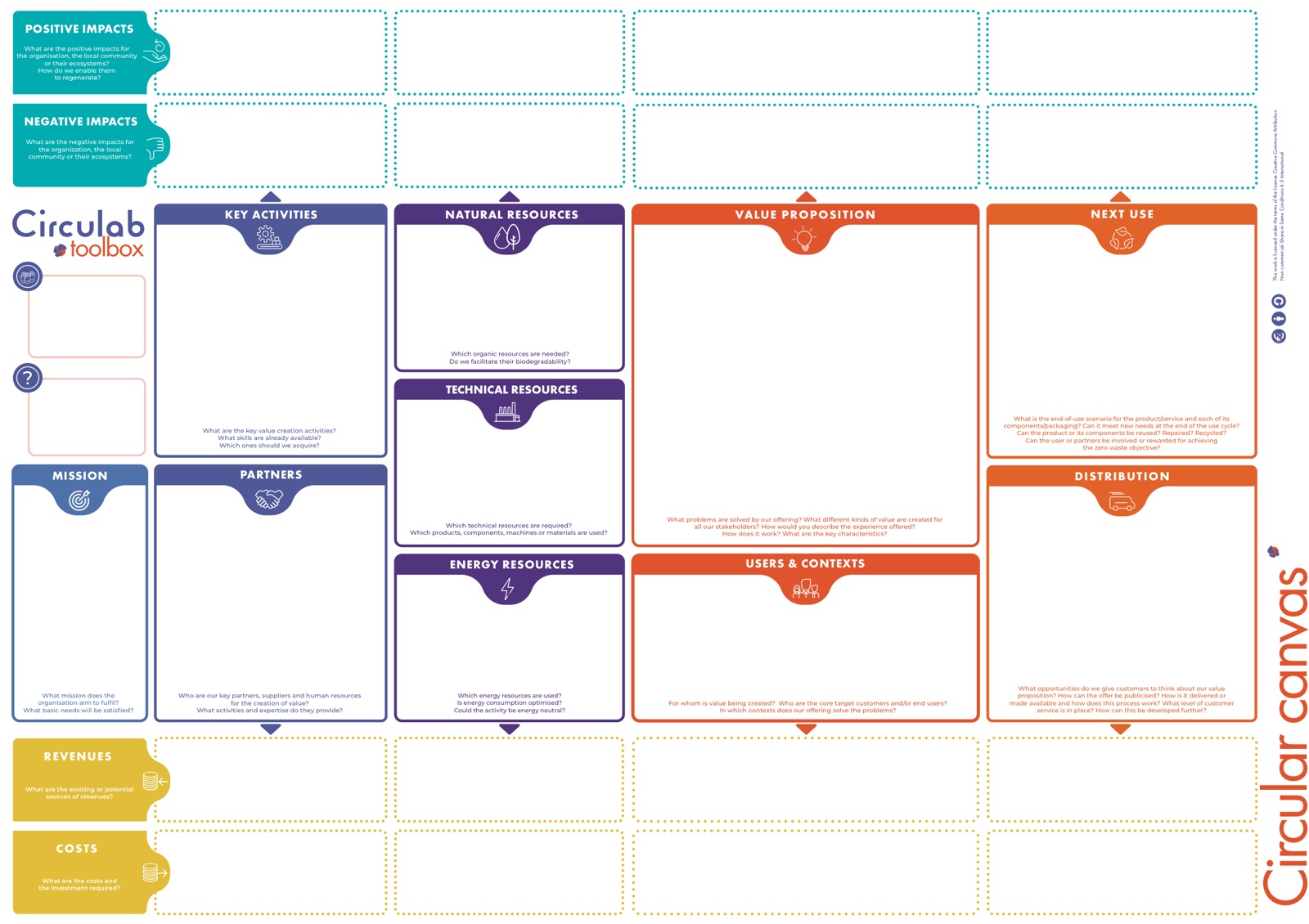
Circular Canvas
To rethink your business model and identify circularity levers at every stage (resources, actors, value, impacts).
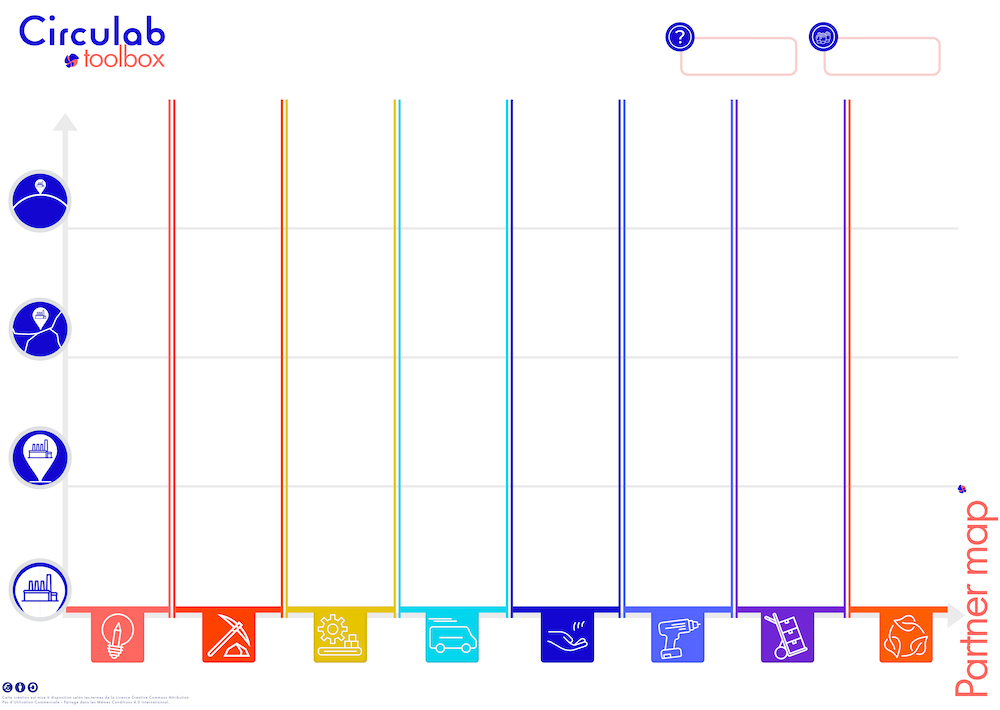
Partner Map
To understand and activate your ecosystem of actors and create shared value.
Value Chain Canvas
To visualize value flows and spot dependencies, losses, and opportunities in your value chain.
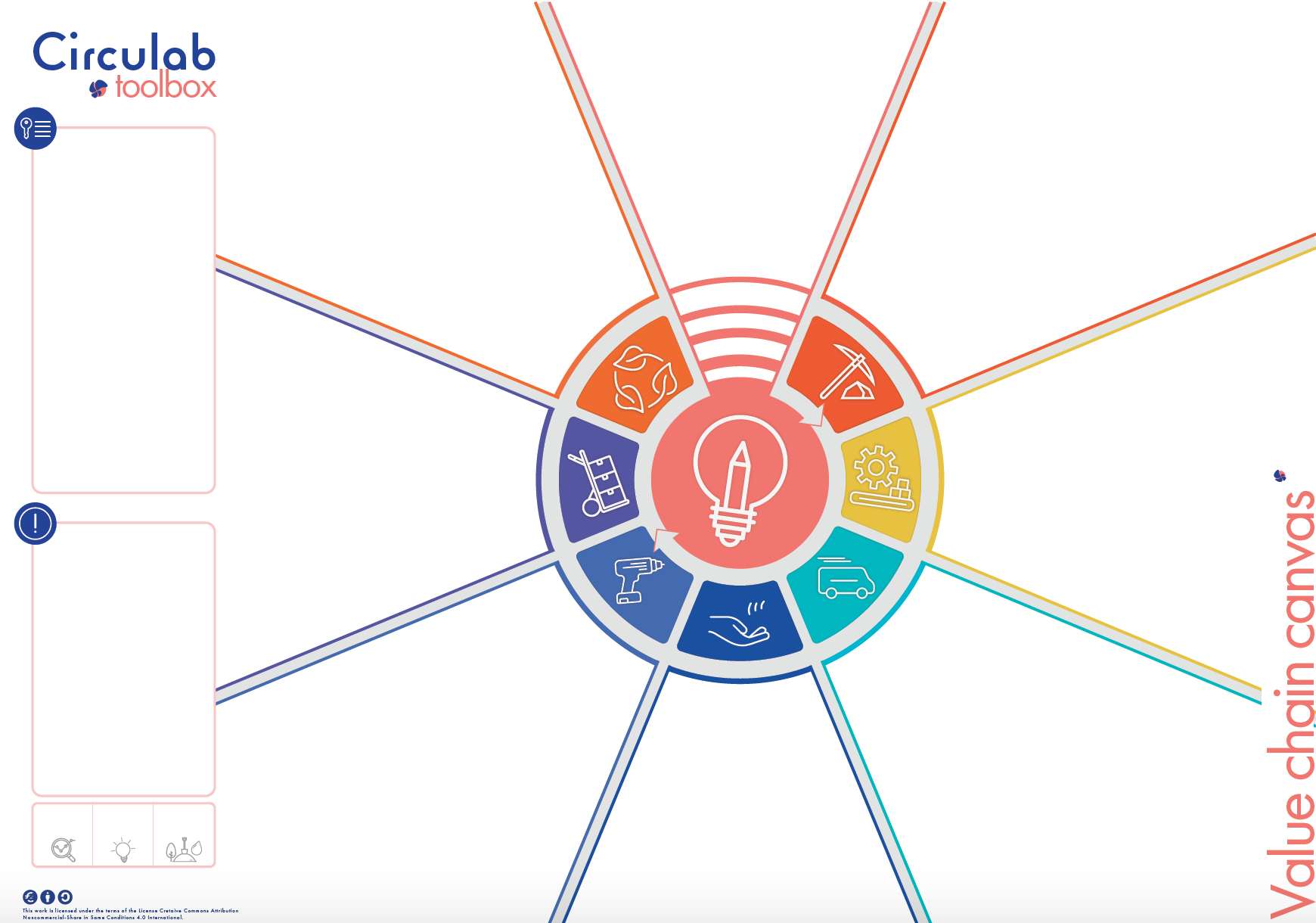
These tools let you see beyond the product, identify interdependencies, and build strategies aligned with the realities of your territory and market.
This pragmatic, visual, collaborative approach is what gives the Circulab method its strength. It's a way of designing not "just another product," but a sustainable, resilient system.
Why get trained in eco-design and the circular economy?
Companies today operate in an unstable, complex environment, constrained by various factors.
In this context, getting trained in new economic models and the various means and tools for building these new systems is essential, and represents a significant competitive advantage and a way to guarantee the resilience and longevity of your business.
An uncertain, volatile world
Supply chains are under strain, raw materials are becoming scarcer and more expensive, and the effects of climate change are being felt at every stage of production.
The 2022 mustard seed shortage is a good illustration of this fragility. Following a major drought in Canada and the war in Ukraine, the supply chain of French manufacturers suddenly collapsed. The consequences included empty shelves, soaring costs, and brands forced to reformulate their recipes or rethink their logistics chains.
This crisis was a reminder of how much dependence on a single resource or a distant geographic origin can weaken an entire industrial model.
These disruptions reveal a simple truth: we can no longer keep operating within our current linear model, which is now reaching its limits.
In this world under pressure, companies that integrate eco-design and circular economy principles into their practices gain a clear advantage:
- Reduced dependence on critical resources.
- Improved energy and material efficiency.
- Differentiation through more durable, desirable products.
- A different way of creating value.
Eco-design thus becomes a strategic response to uncertainty, helping organizations rethink their offerings, anticipate crises, and build more sparing, resilient models.
A regulatory context that's changing the rules of the game
At the same time, environmental regulations are intensifying and profoundly transforming market requirements. In Europe as in France, companies must now account for the environmental impacts of their products throughout their life cycle.
To give you a few examples:
- The European Regulation on Ecodesign for Sustainable Products (ESPR) extends the approach to all products and introduces the digital product passport, designed to trace the origin and environmental impacts.
- Companies are encouraged to implement life cycle assessments (LCA), improve their environmental labeling, and integrate sustainability and circularity principles into their processes.
Getting trained in eco-design and the circular economy ultimately means anticipating these changes rather than enduring them. It's also a significant opportunity to turn a regulatory constraint into a lever for innovation and competitiveness, notably by developing offerings that meet new standards while creating long-term value.
In short
Faced with a world where resources are becoming scarcer, costs are rising, and regulatory requirements are tightening, eco-design and the circular economy are no longer topics to overlook. They're strategic levers to guarantee the sustainability and competitiveness of businesses.
Getting trained in these approaches means learning to design differently, to integrate the environment from the design stage, to anticipate risks, and to rethink your business model within a logic of virtuous loops. It also means equipping yourself with a systemic vision capable of turning constraints into innovation opportunities.
To that end, we recommend the in-house training Starting an Eco-Design Approach with the Circular Economy. It's an opportunity to take, as a team, the first step toward more sparing, high-performing, sustainable models.