In a context of rapid change in markets, regulations and societal expectations, acquiring new skills related to the circular economy has become essential for anyone in work. Whether you are a CSR manager, buyer, project manager, product engineer or executive, you now need to rethink your models and practices to align them with planetary boundaries.
What you should remember:
- The world is changing fast, and pressures on resources, ecosystems and value chains keep intensifying.
- Training in the circular economy is a way to seize the opportunities ahead.
- Circulab Academy offers a personalized learning path based on your objectives.
- OPCO, CPF, France Travail: an overview of the funding schemes available on the market.
Why train in the circular economy?
A world under pressure
Supply chains are under strain, raw material prices fluctuate, ecosystems are weakening. Take sand, for example, a resource we think of as inexhaustible: with more than 50 billion tonnes extracted every year, it has become the second most consumed resource in the world after water, to the point of endangering entire coastal areas and fueling geopolitical tensions along coastlines.
The circular economy, a significant opportunity
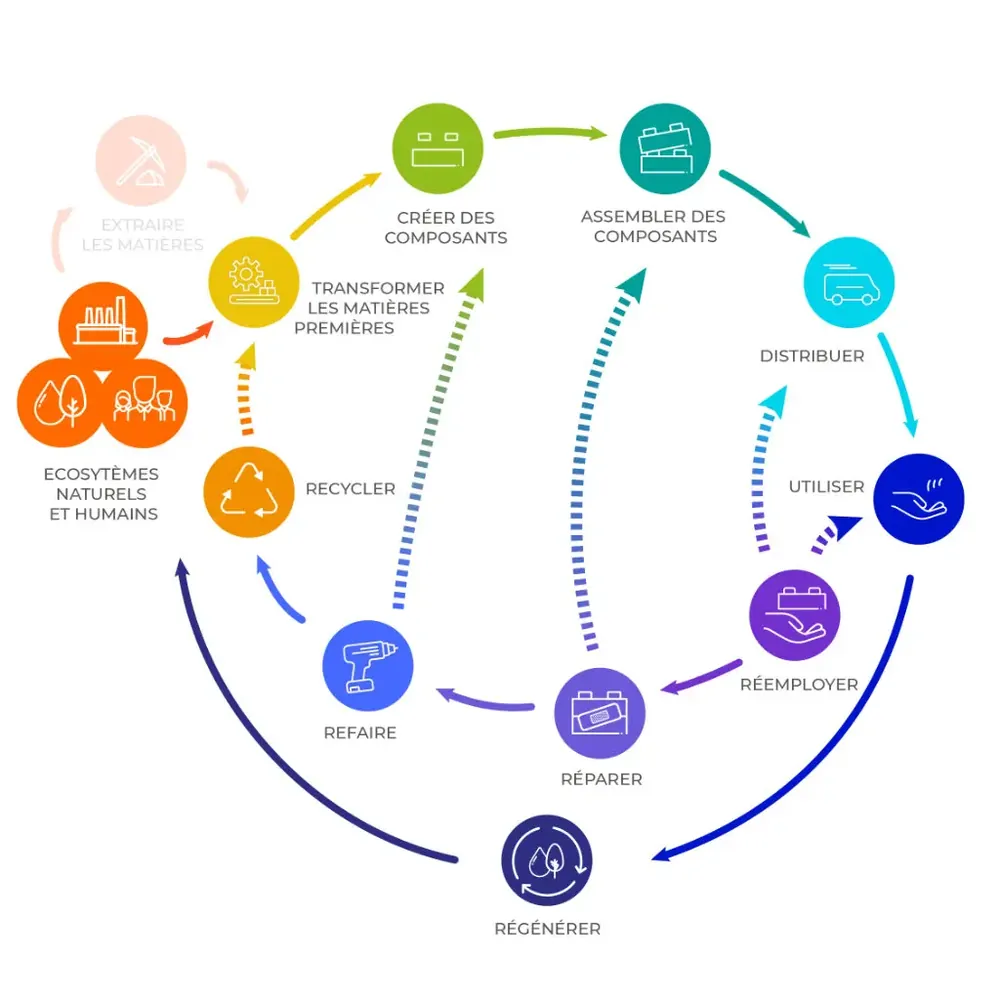
At Circulab, we prefer to see the ecological transition as a tremendous lever for innovation, meaning and sustainable performance. Activating the circular economy means doing "better with less". Training your teams on these issues also means bringing your organization into a virtuous dynamic of transformation.
How to choose your circular economy course?
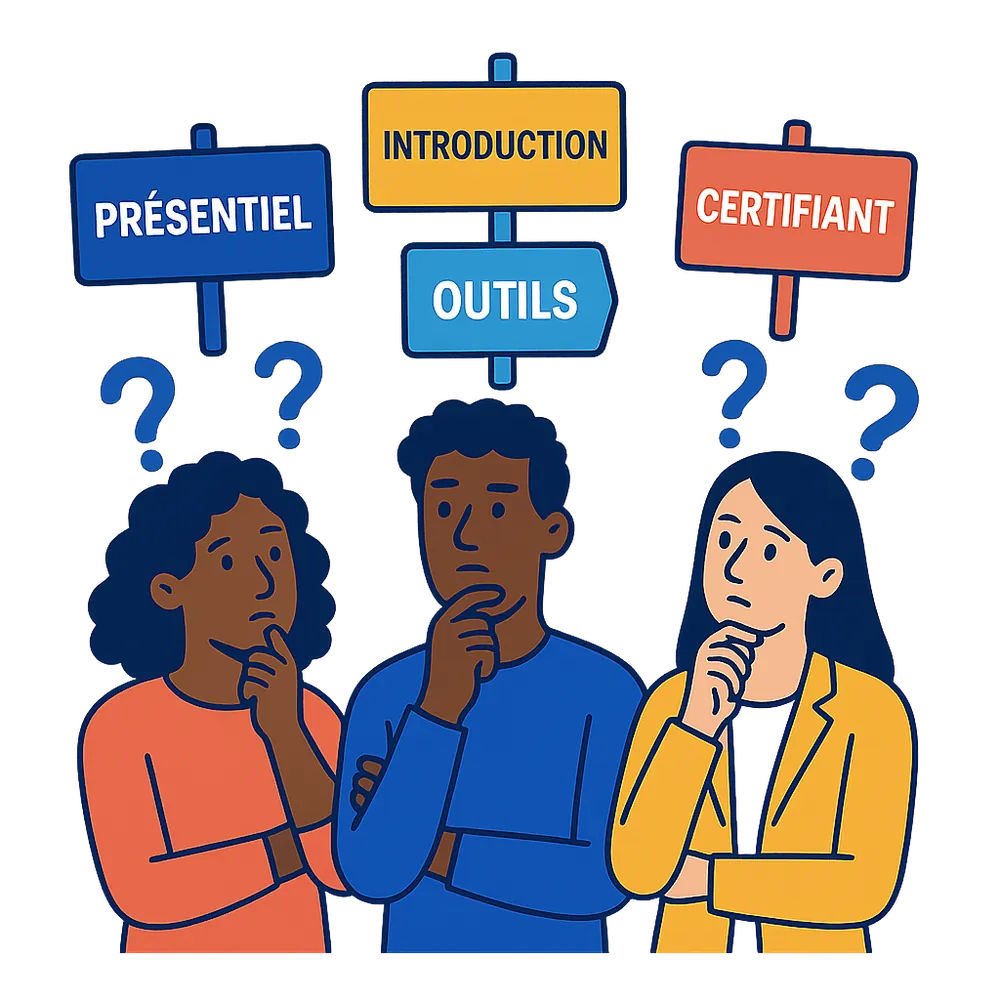
Consider the teaching format
Initial training: degree programs for students or people changing careers, which integrate the circular economy as a common thread or a module.
Continuing training: for working professionals, shorter and more targeted, to build skills without putting your professional activity on hold.
In person or remote, synchronous or asynchronous: in-person training encourages exchanges and collective experimentation. Remote training lets you learn at your own pace. Synchronous means live sessions with a trainer; asynchronous is a self-paced path (videos, quizzes). The right choice is the one that respects your availability and the way you learn.
Choose according to your level and objectives
Do you want to be able to talk about it with those around you? Become an expert and create a roadmap? Or master methods and tools to deploy the circular economy? Go back to your initial objective to choose a suitable course.
Choose a degree or certified course
Some courses are informative, others issue a certificate of attendance, an end-of-course certificate, or even a qualification recognized in the RNCP (the French national register of professional certifications) — something to take into account if you are in transition, looking for a job or part of an internal training plan.

What circular economy courses are available?
Professional, customizable courses
Circulab Academy offers 9 courses across 4 levels:
- Discover: the basics (definitions, pillars, systemic challenges, business models, circularity indicators).
- Apply: to roll out a CSR and circular approach day to day.
- Deploy: to put a circularity strategy in place.
- Get equipped: to master the tools and the Circulab method, recognized for more than 13 years.
What people who took the training say
“Circulab gave us very practical content and exercises with a step-by-step approach based on learning by doing.”
Stephen Demange, SQLI
“Circulab takes part in our Executive MBA on sustainable innovation. The team enables participants to take ownership of the circular economy and to develop their ability to generate sustainable business models.”
Stéphane Canonne, EDHEC Business School
“The training is very positive, I find the methods very useful and the tools very well designed for taking action.”
Maribelle Mendanha, BNP Paribas
“The relevance of their tools and the accuracy of their teaching allow participants to leave with simple actions that can be put in place quickly.”
Caroline Isidore-Weibel, The Camp
“The training gave me a reconnection with nature and industry. A completely new perspective, complementary to strategy and design-led innovation skills.”
Hubert Tassin de Montaigu, Orange Business Services
How to fund your circular economy course?
If you are an employee or an executive
OPCO funding (Opérateur de Compétences, the French skills operators) is an option. As Circulab is a Qualiopi-certified training organization, this makes it easier to access funding through OPCOs, as part of a skills development plan or collective actions. Contact your OPCO or your Human Resources Manager.
If you are a job seeker
Contact your France Travail advisor to activate the Individual Training Aid (AIF), which can be used even for non-certifying courses, provided you demonstrate the consistency of your professional project.
If you are self-employed
You can use your FAF (Fonds d'Assurance Formation, training insurance fund) such as FIF PL, AGEFICE or FAFCEA, or an OPCO depending on your activity. Circulab Academy courses are not eligible for the CPF (the French personal training account), but flexible payment options and support in setting up your training project are available.
In short
Training in the circular economy is much more than a step towards the future: it is a strategic and necessary act. Whether you are curious, a project leader, a committed employee or in transition, there is a course for you. At Circulab, we believe that it is by combining systemic understanding, cooperation and applied teaching that we accelerate transformation.
Sources:
- UNEP, Sand and Sustainability: 10 strategic recommendations to avert a crisis (April 2022)
- France Compétences, search engine to find your OPCO
- France Travail, Individual Training Aid (AIF)